Be Indiscrete: The Benefits of Learning Continuous Spine Degeneration Severity Scores
Jun 2026· ,,,,·
1 min read
,,,,·
1 min read
Maria Monzon
Andrew Zisserman
Robin Y. Park
Catherine R. Jutzeler
Amir Jamaludin
Abstract
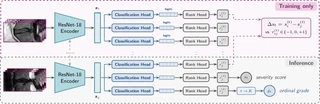
Lumbar spine degeneration is a major contributor to chronic low back pain and is routinely assessed on MRI using ordinal grading systems, e.g. normal, mild, moderate, severe. Consequently, most approaches to train models to grade these MRIs formulate grading as a multi-class classification problem, treating ordinal grades as categorical, ignoring differences in misclassification severity, and imposing hard decision boundaries on a continuous disease process. This work explores modeling spinal degeneration as a continuous severity ranking problem. We introduce SpineRankNet, a framework that learns scalar severity scores from lumbar spinal MRI, and compare it against multi-class classification and ordinal regression. Using multiple degeneration measures from the Genodisc dataset, we show that a model trained using a ranking loss to produce a continuous score enables fine-grained ordering of MRI scans. Furthermore, the ordinal grading classes can be recovered from the score with comparable accuracy to those from a model trained directly for classification. The score learned by ranking even improves discrimination between more distant classes.
Type
Publication
Medical Image Computing and Computer Assisted Intervention (MICCAI)
Carried out during a visiting research stay at the University of Oxford — Visual Geometry Group (Prof. Andrew Zisserman’s group). Keywords: Pairwise Ranking · Ordinal Regression · Spine Degeneration · MRI.

Authors
Maria Monzon
(she/her)
Computer Vision & Medical AI Researcher
PhD candidate at ETH Zurich developing robust and trustworthy deep learning for medical image analysis — spine and cardiac MRI, multimodal biomedical data, and uncertainty quantification. Previously a computer-vision researcher at BASF, where I deployed models to production in regulated, GLP-certified environments. I care about efficient code and reproducible research.